Understanding Automotive Electrical Systems
Common Electrical Problems in Vehicles
Your car moves only when its circuits move current. Electricity feeds the starter, the fuel pump, every sensor, and the dashboard. In Margate, where humidity and salt air linger year round, those circuits face constant stress.
Common electrical problems in vehicles usually trace back to a few sources. Corroded battery terminals, failing alternators, damaged wiring, and worn starter motors account for most failures.
- Battery terminal corrosion from moisture and salt
- Alternator diodes that fail under heat
- Wiring insulation cracked by sun exposure
These faults show up as dim lights, slow cranking, or odd warning lamps. A margate auto electrical workshop can diagnose these issues quickly. Catching them early saves you from roadside trouble.
Signs Your Car Needs Electrical Attention
I’ll be honest, most drivers never think about their car’s electrical system until something refuses to start. Understanding it comes down to one principle: every component demands steady voltage. The engine control unit, the fuel injectors, even the stereo, they all rely on a consistent flow. A small drop in power causes strange behaviour that seems unrelated to electricity.
Signs your car needs electrical attention are subtle. Watch for:
- Power windows that move slower than usual
- Interior lights that pulse when the engine idles
- Fuses that blow repeatedly for no clear reason
Each symptom points to a deeper issue in the circuit network.
In Margate’s coastal conditions, these clues deserve prompt attention. A margate auto electrical specialist can trace the fault to its source without guesswork.
The Role of a Professional Auto Electrician
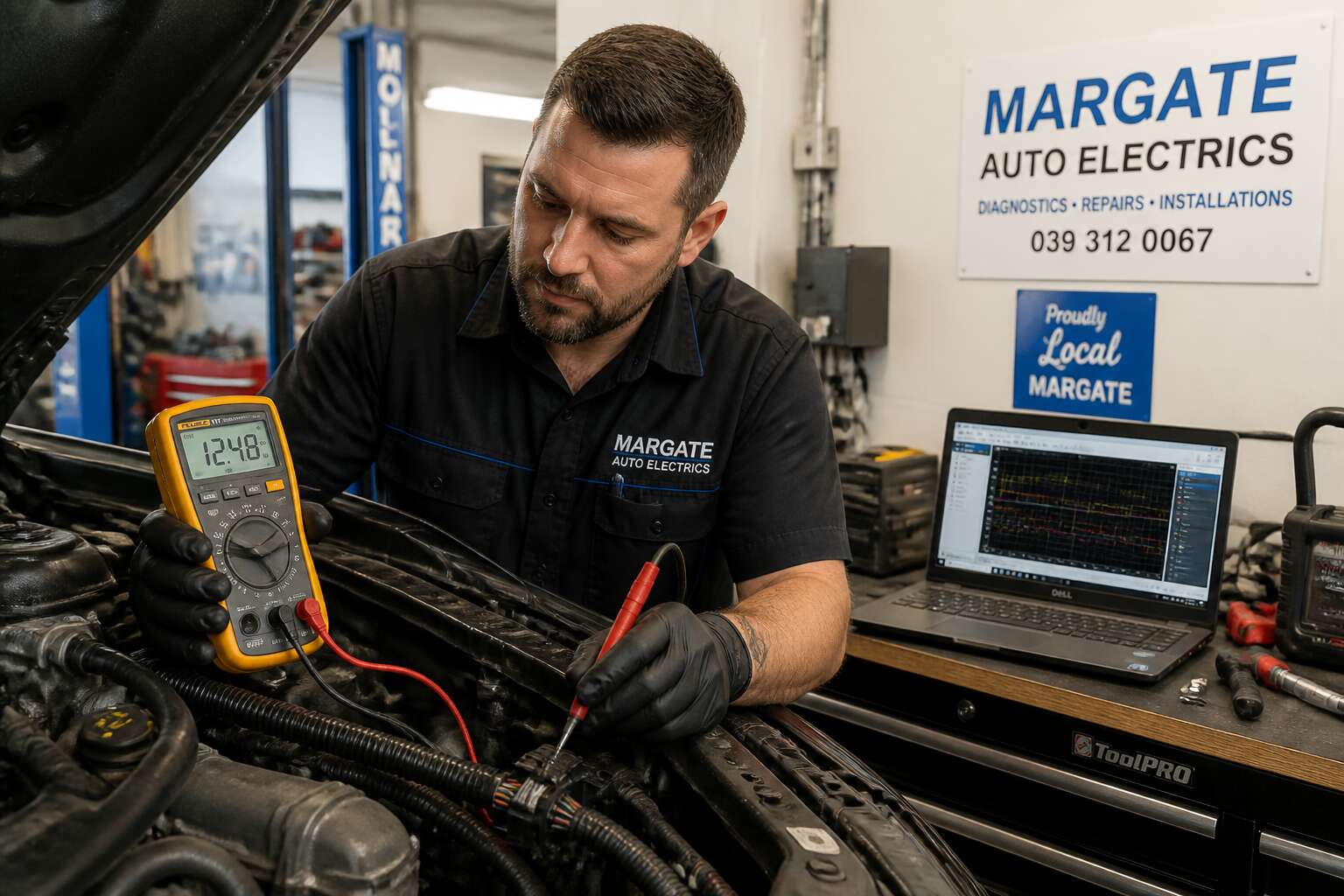
Understanding automotive electrical systems requires patience. A vehicle’s wiring harness carries current to dozens of modules, and each connection demands precision. A margate auto electrical specialist approaches every circuit methodically, from the battery terminal to the last earth point.
Modern vehicles in this coastal town face constant exposure to salt air and humidity. These conditions accelerate corrosion on terminals and connectors, increasing resistance and reducing voltage. I’ve watched simple corrosion cause failures that baffled less experienced mechanics.
The diagnostic approach involves:
- Tracing wiring diagrams to isolate circuit interruptions
- Testing voltage drops under real load conditions
- Inspecting earth points for hidden corrosion
A margate auto electrical expert uses diagnostic equipment to pinpoint faults without guesswork. This methodical process protects both the vehicle and the owner’s budget.
How Modern Electronics Depend on a Healthy Wiring Network
Contemporary vehicles contain several kilometres of wiring and dozens of control modules. Any interruption in that network sends confusing signals to every component downstream. A healthy wiring network means stable voltage, clean data transmission, and predictable behaviour from systems that drivers take for granted.
Consider what happens when resistance creeps into a single connector. The engine may idle roughly, or the transmission might shift late, while the diagnostic reader shows no fault code. This is where a margate auto electrical specialist earns their keep, measuring actual current flow rather than relying on what the computer reports.
- CAN bus networks carrying real time data between modules
- High current circuits feeding electric power steering and heating elements
- Sensor loops monitoring tyre pressure and brake wear
A single weak earth point undermines all of it. Voltage follows the path of least resistance, and when that path is unintended, modules behave erratically. That is the difference between guesswork and lasting repair.
Services Offered by Auto Electricians in Coastal Areas
Diagnostic Testing and Fault Finding
Coastal air is relentless. It attacks wiring looms, sensor connectors, and alternator diodes. A vehicle can run without fault for weeks, then refuse to start on a random Tuesday. This is why diagnostic testing in Margate demands more than a multimeter and a hunch.
At margate auto electrical, fault finding starts with a systematic sweep of the entire circuit. We measure voltage drops under load, not just at rest. We inspect ground points, because corrosion loves an earthing strap. We also monitor parasitic drains, which flatten batteries overnight.
- Thermal imaging of fuse boxes
- Waveform analysis on alternator output
- Load testing of starter circuits
Every test has a purpose. We track down the issue instead of replacing parts in hope. The result is a diagnosis you can trust, and a repair that outlasts a season of sea spray. Margate auto electrical leaves nothing to chance.
Battery and Charging System Services
Most drivers don’t think about their battery until the engine clicks once and falls silent. In a salty coastal climate, that silence happens sooner than expected. Margate auto electrical offers battery and charging system services that address the root causes of failure, including corrosion, heat stress and electrical strain.
We test reserve capacity and cold cranking amps under real load. We inspect alternator output at different engine speeds. We check the voltage regulator and the belts that drive it. Batteries die faster in heat and humidity, so we measure how your electrical demands affect the system.
Our services include:
- Load testing with a carbon pile tester
- Alternator and regulator testing
- Battery terminal, cable and clamp cleaning
- Parasitic draw checks
The final step is a full charging system check. Margate auto electrical tests the alternator, regulator and battery together, because any overlooked fault leaves you stranded.
Wiring Repairs and Installations
Salt air corrodes every unprotected connection. It creeps into looms, connectors and earth points. A single corroded splice causes intermittent faults that defeat most scan tools. At margate auto electrical, we address wiring faults at the source rather than hiding them under tape.
We replace damaged harness sections. Cracked insulation and green crust on pins get stripped out. Fresh runs follow factory routing, because a wire rubbing against a bracket becomes tomorrow’s short circuit. Coastal humidity accelerates every weakness.
For new equipment, we install:
- Relay and fuse protection on every added circuit
- Marine grade heat shrink at each connection
- Corrosion resistant terminals with dielectric compound
- Secure looms that withstand coastal vibration
Lighting and Accessory Fitting
Coastal driving demands more from your vehicle’s lighting than any inland route. Fog banks roll in without warning, and spray from passing traffic leaves a film on every lens. At margate auto electrical, we fit lighting systems that cut through this maritime haze. LED light bars, spot lamps, and upgraded headlight harnesses all receive sealed connectors, marine grade terminals, and routing that keeps water away from vulnerable electronics.
Accessory fitting follows the same discipline. A winch, a dual battery system, or a set of auxiliary reverse lights only performs when its wiring survives the salt. We install:
- Corrosion resistant fuse holders for every new circuit
- Dielectric grease on all plugs and sockets
- Braided sleeving over exposed cables
Each installation is tested under load, because a flickering light on a dark coastal road is more than an annoyance. It is a hazard. The salt air corrodes everything, and our work must outlast it.
Engine Management and Sensor Calibration
Coastal driving punishes engine management systems. One faulty sensor can change fuel delivery, ignition timing and emissions. The salt laden air in Margate corrodes connectors and delicate components. margate auto electrical therefore focuses on precise sensor calibration and complete engine management checks. Key sensors to monitor:
- Oxygen sensors
- Crankshaft position sensors
- Mass airflow sensors
Each needs a stable voltage and a clean earth path. Corrosion on a pin sends false readings to the ECU. The result is rough idling or poor fuel economy. Our diagnostic tools trace these issues to their source. Then we recalibrate the system instead of replacing parts blindly. For coastal drivers in South Africa, accurate data depends on sustained attention to wiring and connections.
Why Choose a Local Specialist for Your Vehicle’s Electronics
Expertise with Coastal Climate Challenges
Coastal vehicles experience up to 30% more electrical faults than inland cars. In Margate, humid air and salt spray attack every connector and fuse. Last year, a neighbour’s SUV failed to start twice in one week. The cause? Corrosion inside a control module, invisible until a specialist traced the fault.
Modern cars rely on sealed electronic units, but these units are not sealed against ocean air. The threat is subtle. A specialist who lives here understands the road salt film under the bonnet and the way dampness settles into wiring looms overnight. Choosing a local expert for your margate auto electrical needs means choosing someone who has seen these failures first hand, with a memory of past issues and the pattern of the weather.
Their judgement matters. They know that a coolant sensor on a driveway in Margate behaves differently than one in a Johannesburg workshop. This familiarity helps them find problems faster, saving you time and frustration. It also means your car is repaired with components suited to coastal conditions, not generic replacements that will rust again. For reliable margate auto electrical work, the local specialist is the difference between a quick fix and a lasting one.
Quick Turnaround and Mobile Support
Your car stops responding, and you have somewhere to be. Waiting days for a workshop appointment only makes it worse. A local specialist for margate auto electrical can often be at your door the same morning. No towing, no waiting, no hassle.
Mobile support is exactly what it sounds like. The technician arrives with a fully stocked van, ready to test circuits and repair faults on site. Many common electrical issues are resolved within the hour. That speed comes from proximity. Local knowledge means travel time is short, and scheduling is flexible.
- Battery failures and jump starts
- Alternator and starter checks
- Wiring and connector repairs
Margate auto electrical work does not need to shut down your day. A specialist who understands the area gets you back on the road faster.
Warranty and Quality Assurance
A warranty is a promise. When you choose a specialist for your margate auto electrical needs, that promise carries real weight. You are not just paying for a repair. You are paying for the confidence that the work will last. Local technicians have a reputation to protect in the community. They cannot afford to disappear after a shoddy job. Their business depends on your recommendation to your neighbours and friends.
Quality assurance starts with the parts. A reliable specialist will not fit cheap, generic components that fail within months. They use quality parts that match your vehicle’s specifications. They also back their labour with a clear warranty. If the same fault returns, they will fix it without fuss.
Here is what a solid warranty typically covers:
– The specific electrical component replaced or repaired
– Labour costs associated with the re-diagnosis
– A defined period, usually six to twelve months
I have seen the difference this makes. A written guarantee changes the dynamic. It shifts the risk from you to the technician. They have a tangible reason to do the job correctly the first time. In the small-town environment of Margate, a handshake and a smile are not enough. You want the paperwork. A local operator understands this expectation and will meet it. That accountability is a form of protection that a distant, anonymous workshop cannot offer.
Knowledge of Regional Vehicle Models
A local specialist sees the same vehicles on Margate roads every day. That familiarity breeds practical knowledge. When you need margate auto electrical assistance, the technician already knows the common failure points of your particular make and model.
Regional vehicle models matter because South African spec cars differ from their global counterparts. Heat, dust and humidity place unique stress on electrical systems. A technician who works on these vehicles daily understands those pressures.
Here is what this local knowledge delivers:
- Faster diagnosis of model specific faults
- Accurate identification of the correct replacement parts
- Awareness of factory recalls and known issues
This expertise translates into fewer guesswork repairs. The technician has likely solved your exact problem before.
Building Long-Term Relationships with Customers
Your car has electrical moods. Some are charming. Most are not. A specialist who sees your vehicle repeatedly learns to interpret those moods without a lengthy interrogation. When you request margate auto electrical assistance, the technician already knows that your rear window regulator hesitates in July or that your central locking sulks after heavy rain.
Long-term relationships create a repair history that no computer can fully capture. The specialist remembers the wiring loom they repaired eighteen months ago. They recall which battery you bought and how your daily commute taxes the alternator. This accumulated knowledge makes each visit quicker and more accurate. You stop explaining your car to strangers.
Consistent care builds a working partnership:
– The specialist spots slow deterioration before it strands you
– Replacement parts match what was fitted before
– You receive straight answers because repeat customers are the business foundation
That continuity matters. It is the reason your neighbour’s car still runs smoothly after a decade of local servicing.
Troubleshooting Common Electrical Issues Before Visiting a Mechanic
Checking Fuses and Relays
A surprising number of electrical faults trace back to a single blown fuse. Before calling a margate auto electrical professional, a five minute inspection of the fuse box can save hours of frustration. A blown fuse often reveals itself through a broken filament or scorched plastic casing. Some fuses appear intact to the naked eye, which is where a fuse puller becomes essential.
The relay panel deserves equal attention. Relays manage high current circuits and can fail silently. Swapping a suspect relay with a known working unit of the same rating isolates the problem immediately.
For a thorough check, keep these on hand:
– A torch or phone light
– A fuse puller or needle-nose pliers
– The vehicle’s wiring diagram from the owner’s manual
If the fault persists after replacing fuses and relays, contact margate auto electrical for a proper diagnostic session.
Inspecting Battery Connections
“The battery terminals are corroded, so your car won’t start.” It is the automotive equivalent of a doctor blaming a splinter for a broken leg. Corrosion on battery posts is a genuine culprit, but it is often a symptom, not the disease. Before you surrender your hard-earned rand to a repair shop, a simple inspection of the battery connections can prevent a major financial sting.
At the top of the underhood hierarchy sits the battery. The terminals are the gateway for every electrical pulse in the vehicle. Those fuzzy, blue and white deposits are a sign of acid vapour escaping, which creates resistance. Tightening a loose cable clamp sounds basic, but a slight wiggle can produce a completely dead car. Use a wire brush to clean the posts and the inside of the clamps. Reattach them securely, starting with the positive terminal, then the negative.
A standard checklist for this roadside ritual includes:
1. A pair of insulated gloves
2. A wire brush or dedicated terminal cleaner
3. A small amount of petroleum jelly
4. A socket wrench for the clamp bolts
The application of petroleum jelly after cleaning prevents future oxidisation. It is a cheap trick that works. If the car fires up immediately, you have saved yourself a call to margate auto electrical. If the engine turns over slowly, the issue might be a deeper battery health problem rather than a mere connectivity issue. Pay attention to the cable itself for any stiffness or cracking in the insulation, as this indicates copper fatigue that no amount of cleaning will fix. A professional utilises a load tester to determine the true state of the battery, something a home mechanic cannot accurately replicate with a simple multimeter. But for a quick fix, this hands-on check is your first defensive play.
Assessing Alternator Output
Alternator failure gives you one silent symptom after another. Headlights dim at traffic lights. The radio cuts out when you indicate. The battery warning light flickers on and then disappears, leaving you guessing.
You can assess alternator output with a basic multimeter. Start the engine and let it idle. Set the meter to DC voltage and place the probes on the battery terminals. A healthy reading sits between 13.8 and 14.4 volts. Anything lower means the alternator is falling short. Anything higher points to a voltage regulator working too hard.
A quick load test requires:
- Switch on the headlights and air conditioner
- Rev the engine to around 2,000 rpm
- Watch the voltage reading
A healthy alternator holds the voltage steady under load. If it dips sharply, the alternator is fading. A home multimeter gives a rough clue, but the load testing equipment at margate auto electrical measures the actual output of your charging system.
Identifying Parasitic Drains
Most drivers overlook the fact that a fully charged battery can lose its charge overnight for one simple reason. A parasitic drain is an electrical component that continues drawing current after the ignition is off. The average margin is 50 milliamps, but something as small as a boot light staying on can triple that demand.
You can test for a drain using a multimeter in ammeter mode. Disconnect the negative battery terminal and connect the meter in series between the terminal and the battery post. Do not start the engine, and keep all doors closed.
– Wait five minutes for modules to sleep.
– Observe the reading on the meter.
– Remove fuses one at a time until the reading drops.
When you find the offending circuit, you are halfway to solving the issue. But some drains are intermittent, and chasing them becomes a game of patience. That is where margate auto electrical technicians use advanced diagnostic tools to pinpoint the fault without guesswork. A 200mA drain may not sound significant, but it drains a 60Ah battery flat in roughly ten days.
When to Call a Professional
When your car’s electrical system starts acting up, the range of possible causes can feel overwhelming. Before you spend money on spares or labour, there are a few checks you can do at home with basic tools. This is not about fixing complex faults, but about eliminating the simple ones that waste your time.
Start by looking at the obvious culprits like corroded terminals or a loose earth strap. A simple visual inspection of the battery clamps often reveals a poor connection. You can also use a multimeter to verify the battery voltage sits near 12.6 volts with the engine off. These are straightforward tasks for any owner.
For those who want to be methodical, consider this sequence:
- Check that all interior and boot lights switch off when closed.
- Inspect the main fuse box for blown fuses related to the fault.
- Listen for unusual relay chatter when the ignition is cycled.
If these steps do not resolve the issue, the problem usually lies deeper in the wiring loom or a failing module. Intermittent failures, where components work one day and not the next, often point to rubbed wires or a failing sensor. This is where the expertise of margate auto electrical specialists becomes necessary. Their diagnostic equipment reads live data that a standard OBD scanner cannot access.
Attempting to bypass safety systems or patch wiring without proper training can lead to more damage. Professional technicians know how to trace a short circuit through complex networks without creating new problems. For the average driver, knowing the limit of your own spanners is just as valuable as knowing how to use them.
Maintenance Tips to Extend Your Vehicle’s Electrical Lifespan
Regular Inspection Routines
Coastal Margate’s salt-laden air tests a vehicle’s electrical system in ways interior suburbs rarely experience. Proactive maintenance, rather than reactive repairs, keeps your car reliable. Margate auto electrical specialists often spot damaged insulation or high resistance connections before failures occur.
A routine inspection should examine wiring harnesses for abrasion marks, especially where they pass through metal grommets. Heat and vibration degrade cable sheathing over time, exposing conductors to moisture. Pay attention to connector housings; brittle plastic and green corrosion indicate water ingress.
- Apply dielectric grease to exposed connectors after cleaning
- Secure loose harnesses with proper clips or tape
- Inspect earth straps on the chassis and engine block
Catching minor corrosion early avoids cascading failures that strand motorists along the N2. If you are unsure where to look, Margate auto electrical workshops will identify trouble spots. The overlooked components make all the difference for longevity.
Keeping Electrical Contacts Clean
Electrical contacts are where reliability is determined. Corrosion on a terminal is not cosmetic; it is resistance that forces the entire system to work harder. Salt air accelerates this process faster than most owners realise. Margate auto electrical specialists regularly see terminals that appear intact yet fail under load because oxide layers have formed beneath the surface.
Cleaning contacts requires more than a quick wipe with a rag. Use a proper contact cleaner and a soft brass brush to reach the mating surfaces. Reapply a protective coating after cleaning.
Here is what preserves connection integrity:
- Disconnect the battery before any cleaning work
- Inspect each connector for green or white residue
- Dry every surface fully before reconnecting
Neglect often goes unnoticed until the engine refuses to start. A clean contact is invisible, but its absence is unmistakable. Consistency with this small ritual separates stranded motorists from those who drive with confidence. Margate auto electrical workshops understand this dynamic well.
Upgrading for Modern Accessories
Modern accessories draw current even when switched off. The average vehicle loses over 30 milliamps to standby electronics before you add a single aftermarket part. Each gadget nibbles at your battery’s reserve. Here on the South Coast, humidity does its worst, turning constant drain into roadside failure.
Upgrading demands attention to two things: fuse ratings and wiring gauge. Overspec the fuse and you protect nothing. Underspec the wire and you create a resistor that glows. Both scenarios end the same way.
- Check the alternator’s output before adding loads
- Use a relay for anything above 10 amps
- Confirm the earth strap can carry the extra return path
Let margate auto electrical confirm the maths before you cut into the harness. Their test gear measures voltage drop, not guesswork. Expect a margate auto electrical specialist to flag a battery that cannot hold new demand.
Protecting Wiring from Moisture and Corrosion
Moisture finds the smallest breach in a wiring harness. Corrosion creeps along copper, raising resistance until a component stops responding. The cure is routine vigilance.
Inspect rubber grommets where wires pass through body panels. A perished grommet lets water travel inside and attack connectors. Replace any brittle grommet. Apply dielectric grease to exposed connectors; it repels water without interrupting signals.
- Clear drain holes in light housings.
- Seal damaged insulation with adhesive-lined heat shrink.
- Spray terminals with corrosion inhibitor monthly.
Green crust on a terminal calls for immediate cleaning. For deeper issues, a margate auto electrical specialist can trace the path before it reaches the ECU.
Scheduling Seasonal Checkups
The ocean breeze carries salt that settles everywhere, including under your bonnet. Over time, that salt combines with humidity and creates a film on electrical components. Most drivers only notice when something stops working. A simple seasonal checkup can change that.
In South Africa, seasons shift from wet summers to drier winters. Each transition stresses your vehicle’s electrical parts differently. A scheduled inspection before the rains arrive, or before the cold sets in, lets a technician catch wear early. For example, checking the flexi joints in wiring looms and verifying that sensor harnesses are securely seated.
- Verifying the condition of rubber boots around steering column wiring.
- Testing voltage drops across connectors under load.
- Confirming that aftermarket accessories are wired through relays.
These tasks take little time but add years to your electrical system. A local margate auto electrical service can perform them in under an hour. That hour is far cheaper than replacing an ECU after a short circuit! Trusting margate auto electrical means your system gets the specific attention it needs for coastal conditions.
The ocean breeze carries salt that settles everywhere, including under your bonnet. Over time, that salt combines with humidity and creates a film on electrical components. Most drivers only notice when something stops working. A simple seasonal checkup can change that.
In South Africa, seasons shift from wet summers to drier winters. Each transition stresses your vehicle’s electrical parts differently. A scheduled inspection before the rains arrive, or before the cold sets in, lets a technician catch wear early. For example, checking the flexi joints in wiring looms and verifying that sensor harnesses are securely seated.
- Verifying the condition of rubber boots around steering column wiring.
- Testing voltage drops across connectors under load.
- Confirming that aftermarket accessories are wired through relays.
These tasks take little time but add years to your electrical system. A local margate auto electrical service can perform them in under an hour. That hour is far cheaper than replacing an ECU after a short circuit! Trusting margate auto electrical means your system receives attention suited to the coast.
Tracking Warning Lights and Error Codes
In many coastal towns, drivers treat a glowing warning light as a suggestion rather than a verdict. The reality is that modern vehicles generate error codes long before a component fails completely. These codes are the only way the onboard computer can communicate distress, especially when salt laden air begins to affect sensitive circuits.
Tracking these warnings requires more than glancing at the dashboard. A systematic approach involves logging when a light appears, noting the driving conditions at the time, and recording how the vehicle behaves. This data gives a technician relevant context instead of a vague symptom. For example, an intermittent traction control warning that only appears after driving through a puddle points to a moisture issue, not a mechanical fault. Someone providing margate auto electrical services will use this information to isolate the exact circuit.
Error codes themselves are often stored in the engine control unit, but they require a professional scanner to retrieve them properly.
– Retrieving historical codes that no longer trigger the warning light
– Measuring live sensor data to verify the code matches the actual condition
– Checking for communication faults between modules, which often appear as false positives
Cross referencing this information saves time and prevents unnecessary part replacements. A code for an oxygen sensor does not always mean the sensor is faulty. It could mean a corroded connector is sending a bad reading. A qualified margate auto electrical specialist knows how to interpret the layers behind the code.
Keeping a simple log of dashboard warnings also helps identify patterns. If the battery light flickers only during rainy weather, the wiring harness may be absorbing moisture. If the engine management light resets itself after a long drive, a failing alternator could be the culprit. These observations turn a mysterious warning into a solvable problem. The final step is having the system cleared after a repair and then rechecking the codes after a few days of driving to ensure the issue is truly resolved. This cycle of tracking, diagnosing, and verifying keeps your vehicle honest and your electrical system reliable for years to come.

0 Comments